ECE Research Seminar – February 20, 12-1 p.m.
February 13, 2026
Please join us for our February 2026
ECE Research Seminar
February 20, 2026, Friday, 12:00 – 1:00 pm, Simrall 228
https://msstate.webex.com/msstate/j.php?MTID=m1e8651292ac32f5baedde069020690a5
Securing Programmable Multi-hop ISAC Networks: RIS-aided IAB with
Delay Alignment Modulation and Hybrid LLM-Enhanced DRL
Sravani Kurma | sk2135@msstate.edu
Abstract: Reconfigurable intelligent surfaces (RIS) and integrated access and backhaul (IAB) are turning wireless networks into programmable, multi-hop infrastructures. Yet this programmability also expands the attack surface, especially when broadcast backhaul, controllable reflections, and joint sensing and communication share spectrum and hardware. In this work, we present a unified perspective on securing RIS-aided IAB systems using delay alignment modulation (DAM) and learning-driven cross-layer control. DAM intentionally time-aligns multipath replicas at intended receivers, enabling compact single carrier signaling while making unintended receivers suffer residual inter-symbol interference. Building on this, we formulate high-dimensional non-convex joint optimization problems that couple dual beam precoding, RIS phase control, and access backhaul resource splitting and then extend the framework to integrated sensing and communication (ISAC) by jointly optimizing precoding, RIS coefficients, and radar receive filtering to maximize a weighted combination of communication secrecy and sensing secrecy (privacy). To solve these coupled control problems in real time, we develop a hybrid actor deep reinforcement learning (DRL) design that fuses numerical state features with lightweight semantic embeddings from a templated system state description, improving regime awareness and sample efficiency. Across representative RIS IAB settings, the hybrid actor converges up to 42.8% faster and achieves higher steady-state secrecy than MLP-only and LLM-only baselines, with RIS delivering up to 3.2X more secrecy gains over non-RIS deployments. In the ISAC extension, RIS-enabled secure ISAC with DAM achieves up to a 45% secrecy improvement over non-RIS systems, and the hybrid actor further improves secrecy performance over standard actors.
 Dr. Sravani Kurma is an Assistant Research Professor in the ECE Department MSU. She received the B.Tech. degree in Electronics and Communication Engineering from the JNTUH college of Engineering, Jagtial, India, in 2017, and Master’s degree (Gold Medalist) in Communication System Engineering from Visvesvaraya National Institute of Technology, Nagpur, India, in 2019. In 2024, she received a Ph.D. degree in the Institute of Communications Engineering (ICE) from National Sun Yat-sen University, Taiwan. She worked as a Wireless Connectivity Software Intern at NXP Semiconductor, Taipei, Taiwan, from September 2023 to May 2024. Her current research interests include 5G, 6G, Industrial internet of things (IIoT), wireless energy harvesting (EH), cooperative communications, Reconfigurable intelligent surfaces (RIS), Full-duplex communication, cell-free MIMO, ultra-reliable and low latency communication (URLLC), resource allocation, large language models (LLMs), Open RAN, and machine learning for communication.
* For further information, contact:
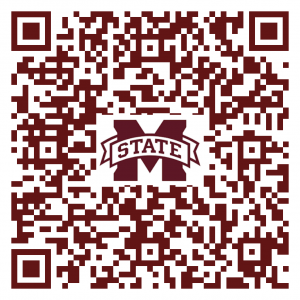
Dr. Jenny Du | du@ece.msstate.edu | 5-2035 For WebEx access,scan the QR code: