


ECE Research Exchange Seminar with Dr. Rahul Bhadani: October 2, 11 a.m. – 12 p.m.
September 21, 2026
Receiver Design for Optical Quantum Communication
Date: Friday, October 2, 2026, 11:00 a.m. – 12:00 p.m.
Location: Simrall 104
Online: https://teams.microsoft.com/meet/299172451408407?p=TXj4hWlQ2qCJx1WKjv
Abstract: An important problem in quantum information theory is the optimization of optical communication channel performance through suitable codewords, receiver designs, and constellation optimization techniques. Many receiver designs have been studied in the past to discriminate between Phase-Shift Keying (PSK) quantum states, which encode information before transmission over the communication channel. Among the various types of quantum states, coherent states are most common for encoding information. In this talk, we discuss optimal receiver design using coherent and squeezed-displaced states to maximize mutual information and reduce the error probability of state discrimination. For pure coherent states, we derive an alternative channel capacity for phase-shift keying using coherent states with a realizable displacement receiver, which is achieved by maximizing mutual information over symbol priors and pre-detection displacement. This capacity is greater than that obtained by maximizing mutual information over symbol priors with zero displacement. Our scheme illustrates the design of an improved, easily implementable receiver that enhances communication performance by tuning it to different photon number regimes. We also investigate the integration of squeezing operations with displacement receivers for state discrimination. Our findings suggest that optimal squeezing at the transmitter side does not enhance performance in terms of the probability of error or mutual information when using displacement receivers. However, squeezing at the receiver side increases mutual information in the low-photon number regime compared to un-squeezed states. We also examine entanglement-assisted communication. The use of pre-shared entanglement provides a distinct advantage over classical communication, particularly in low brightness and highly noisy conditions. We analyze several low-complexity receivers that utilize optical parametric amplifiers. Our work shows that entanglement-assisted receiver designs with phase-shift-keying modulation can surpass classical capacities. We describe a newly proposed 2x2 optical hybrid receiver that outperforms previously proposed optical parametric amplifier-based receivers. Additionally, we discover that using unequal priors for BPSK significantly enhances the information rate, offering about three times the advantage of equal priors. Finally, we present generalized Kennedy receivers for coherent-state communication over turbulent free-space optical channels. An ergodic mutual-information framework is developed to jointly optimize the receiver displacement and input prior probabilities under Gamma–Gamma fading.
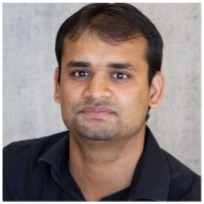 Dr. Rahul Bhadani
Rahul Bhadani is a tenure-track assistant professor in Electrical and Computer Engineering at the University of Alabama in Huntsville. He was formerly a postdoctoral appointee at Vanderbilt University in the Institute for Software Integrated Systems. He obtained his Ph.D. (2022) and M.S. (2017) in Electrical and Computer Engineering, M.S. (2021) in Optical Sciences, M.S. (2022) in Statistics from the University of Arizona, and a B.E. (2012) in Information Technology from Bengal Engineering & Science University in India. His research primarily focuses on dynamical systems with applications in intelligent transportation, energy systems, and quantum communication. He is a recipient of the best paper award at the IEEE Vehicular Network Conference 2017. His teaching interests include model-based design, statistical machine learning, and quantum information processing.
* For further information, contact: ECE 662-325-2035