High Voltage Measurement Techniques

including

Laboratory Demonstrations

May 12 – 16, 2003


Course Lecturers


Stanislaw Grzybowski

Richard Connell


Short Course Agenda

MONDAY, MAY 12

8:00 a.m. – 5:00 p.m.              Registration

11:00 – 11:50 a.m.                  Welcome and Introduction to HV Lab

Noon – 1:00 p.m.                    Lunch

1:00 – 1:50 p.m.                      Electrical Field Distribution and Breakdown

                                                Strength of Insulating Materials

2:00 – 2:50 p.m.                      Electrical Breakdown in Air, Vacuum, SF6,

3:00 – 3:50 p.m.                      Generation of Alternating High Voltage

4:00 - 4:50 p.m                       Resonant AC Testing

5:00 – 7:00 p.m.                      Reception


TUESDAY, MAY 13

8:00 – 8:50 a.m.                      Generation of Direct High Voltage

9:00 – 9:50 a.m.                      Measurement of AC and DC High Voltage

10:00 – 11:50 a.m.                  Generation of Impulse Voltages

                                                (Lightning, Switching, Steep-Front)

Noon – 1:00 p.m.                    Lunch

1:00 – 2:50 p.m.                      Measurement of Impulse Voltages and

                                                Calibration of Impulse Divider

3:00 – 4:50 p.m.                      Demonstration in HV Laboratory on:

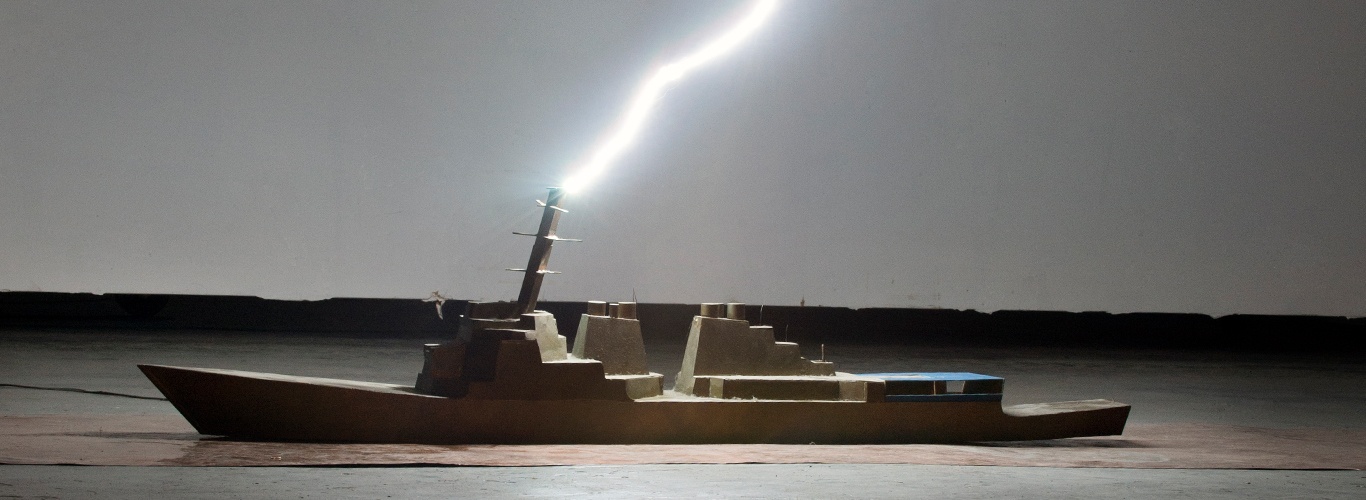
                                                 – Discharges and Breakdown in Air

                                                 – Shaping the Impulse Voltage


WEDNESDAY, MAY 14

8:00 – 8:50 a.m.                      Electrical Breakdown and Strength of Solid

                                                Dielectrics

9:00 – 9:50 a.m.                      Measurement of Dissipation Factor, tan d

10:00 – 11:50 a.m.                  Measurement of Partial Discharges under AC

Noon – 1:00 p.m.                    Lunch

1:00 – 1:50 p.m.                      Measurement of Partial Discharges under DC

2:00 – 2:50 p.m.                      Electrical Breakdown and Strength of Liquid

                                                Dielectrics

3:00 – 4:50 p.m.                      Demonstration in HV Laboratory on:

                                                – Partial Discharge Testing Techniques

                                                – Measurement of Corona

7:00 p.m.                                 Banquet


THURSDAY, MAY 15

8:00 – 9:50 a.m.                      Evaluation of HV Cables

10:00 – 11:50 a.m.                  Safety and Space Requirements in HV Lab

Noon – 1:00 p.m.                    Lunch

1:00 – 2:50 p.m.                      Evaluation of Ceramic and Non-Ceramic

                                                Insulators

3:00 – 4:50 p.m.                      Demonstration of HV Laboratory on:

                                                – Evaluation of CFO

                                                – Fog Test of Insulators


FRIDAY, MAY 16

8:00 – 9:50 a.m.                      Application of Statistical Methods in

                                                High Voltage Engineering

10:00 – 10:50 a.m.                  IEEE Std. 4 – 1995 Standard Techniques For

                                                High-Voltage Testing

11:00 – 11:50 a.m.                  Panel Discussion on Important Topics

                                                Related to HV Measurement Techniques

Noon – 12:30 p.m.                  Course Certificates and Evaluations

12:30 p.m.                               Lunch


About the Short Course


Who Should Attend?

This course is designed to benefit:

•           engineers and technical personnel from utilities, industries, and commercial                

            institutions

•           research laboratory personnel involved in the utilization and/or design of

            high voltage test equipment and the use of test standard

•           test engineers and inspection personnel

•           university faculty and students interested in high voltage engineering


Course Location

The conference will be held in the Division of Continuing Education, located on the beautifully landscaped grounds of Memorial Hall on the campus of Mississippi State University, in Starkville, Mississippi, USA. Memorial Hall boasts a tastefully decorated outside plaza, auditorium, conference rooms, and business offices. Within easy walking distance are the Colvard Union, Bookstore and Grill, Perry Cafeteria and numerous academic buildings and residence halls.


Course Fee and Registration

The course fee is $1,300 and includes a reception, five lunches and a banquet, the IEEE Standard #4-1995, notes of presented lectures, catalogs, and other applicable materials. Course materials are available only to course attendees. Refunds will be made if enrollment is closed or if a letter of cancellation is received by April 28, 2003. Substitutions may be made at any time.


Continuing Education Units

Each participant will receive a certificate from Mississippi State University indicating participation in this short course. Participants who successfully complete this short course will also earn 3.3 continuing education units (CEUs). Participants will receive an official transcript from Mississippi State University’s Division of Continuing Education.


Hotel Accommodations

Attendees are to make their own travel and lodging reservations.  Rooms have been blocked at the following hotels.  To receive the conference discount, please make reservations before April 21 and refer to the High Voltage Short Course.


Comfort Suites                       (662) 324 - 9595                     $79

Hampton Inn                          (662) 324 - 1333                     $79

Holiday Inn Express              (662) 324 - 0076                     $72

Ramada Inn                            (662) 323 - 6161                     $57


For other off-campus lodging information, please contact the Starkville Chamber of Commerce at (662) 323 - 5783, or visit the chamber web page: http://www.starkville.org/tourism/lodging/hotels.html


Transportation

Mississippi State University in Starkville is located on Highway 82, approximately 25 miles west of Columbus, Mississippi. The campus is accessible from U.S. Highway 82 and State Highways 12 and 25. Starkville is located 125 miles northeast of Jackson, Mississippi. Starkville and the university are serviced by the Golden Triangle Regional Airport located 15 miles east of Starkville on Highway 82. Limo service and rental cars are available at the airport. When requested on the registration form, Mississippi State University will provide transportation from and to the airport and hotel.


Maps

Mississippi, Starkville and Mississippi State University maps are available for viewing at our website. The maps are located at the following URLs:


Mississippi:                    http://www.visitmississippi.org/images/Mississippi_Map.pdf

Starkville and GTR:      http://msuinfo.ur.msstate.edu/where/GoldenTriangle.jpg

Full MSU campus map: http://msuinfo.ur.msstate.edu/where/big_campus.htm


Insurance

The organizers cannot be responsible for accidents to conference registrants or for damage to or loss of their personal property howsoever caused. Registrants should therefore make their own insurance arrangements.


For Additional Information

For technical information call Dr. Stan Grzybowski, Course Director, at:

(662) 325 - 2148    or    FAX  (662) 325 - 2298   or  E-mail: stangrzy@ece.msstate.edu


For other information, contact Ms. Teresa Stewart, Program Facilitator, at:

(662) 325 - 8877    or    FAX  (662) 325 - 8666   or   E-mail: tstewart@ce.msstate.edu


To register please complete one of the listed methods of registration.

You will be registered upon receipt of payment or payment instructions.


Fast Registration Online

www.ce.msstate.edu/conferences


Fast Registration by Phone

            (662) 325 - 7330

            8:00 a.m. - 5:00 p.m. CST weekdays

Please have all information on the registration form available.


Fast Registration by FAX

To register by FAX, use the form provided (or a photo copy) and send any time via:

            FAX  (662) 325 - 8666


Registration by Mail

Fill out the registration form completely (or a photo copy) and mail with check or payment instructions to:

2003 Short Course on High Voltage Measurement Techniques

Division of Continuing Education

Attn:  Teresa Stewart

Mississippi State University

P.O. Box 5247

Mississippi State, MS 39762-5247  USA


About the Course Lecturers


Stan Grzybowski received the M.Sc. and Ph.D. degrees in Electrical Engineering in 1956 and 1964, respectively, from the Technical University of Warsaw, Poland.  In 1984, he obtained the Dr. Hab. (Dr. habilitated) degree from the Technical University of Wroclaw, Poland.


In 1956, he joined the faculty of Electrical Engineering at the Technical University of Poznan, Poland.  From 1958 to 1981, he was Head of the High Voltage and Electrical Materials Division and served as Vice-Dean of Electrical Engineering Faculty in 1969 and from 1975 through 1977.  He has been a Visiting Professor at the University of Manitoba, Winnipeg, Canada, the University of South Carolina, and Visiting Scientific Advisor to Instituto de Investigaciones Electricas, Mexico.


In 1987, Dr. S. Grzybowski joined Mississippi State University, where now he is a Professor at the Electrical and Computer Engineering Department.  He is author/co-author of three books in high voltage engineering, three problems books on HV Engineering for students and four IEEE Standards.  He presented his research results in 52 papers published in refereed journals (22 papers in IEEE Transactions) and over 130 research papers published in Proceedings of International and National Conferences.


Dr. S. Grzybowski is a Fellow of the IEEE, IEEE Power Engineering Society, IEEE Dielectrics and Electrical Insulation Society.  He is a member of CIGRE, Tau Beta Pi, and Eta Kappa Nu.


Richard Connell received a Bachelor of Science in Electrical Engineering from Clarkson College of Technology in 1975.


He has been employed at Hipotronics, Inc. since 1975 and has held a variety of design and management positions. His experience includes the design and installation of High Voltage Test Systems, particularly power frequency resonant systems, and also partial discharge testing and analysis.  He presently serves as the Director of Engineering.


Mr. Connell is a member of IEEE and has participated in the Diagnostic Testing Working Group generating the IEEE Guide for Diagnostic Field Testing of Electric Power Apparatus.


About the Institution


Mississippi State University (MSU) forms part of a cohesive town-university community with the growing agricultural-commercial-industrial town of Starkville, located in the eastern part of north-central Mississippi. After more than 125 years, MSU has come to be a comprehensive, doctoral-degree-granting university. As a Land-Grant institution, Mississippi State University is dedicated to three broad purposes: learning, research, and service. Fulfilling these purposes is the chief work of the large number of educational units that make up the total university, including, among others, the academic departments, schools, and colleges; the Division of Continuing Education; the Mississippi Cooperative Extension Service, and the Mississippi Agricultural and Forestry Experiment Station.


The Division of Continuing Education is an academic/service arm of the university that extends educational opportunities, through a variety of learning options, to individuals, groups and agencies in non-traditional program formats. It provides leadership coordination and assistance in implementing lifelong learning opportunities sponsored by Mississippi State University. The undergirding purpose of the Division of Continuing Education is to provide programs tailored to the needs of lifelong learners consistent with the overall objectives, resources and unique capabilities of the university. These programs are enhanced by a rich array of support services.


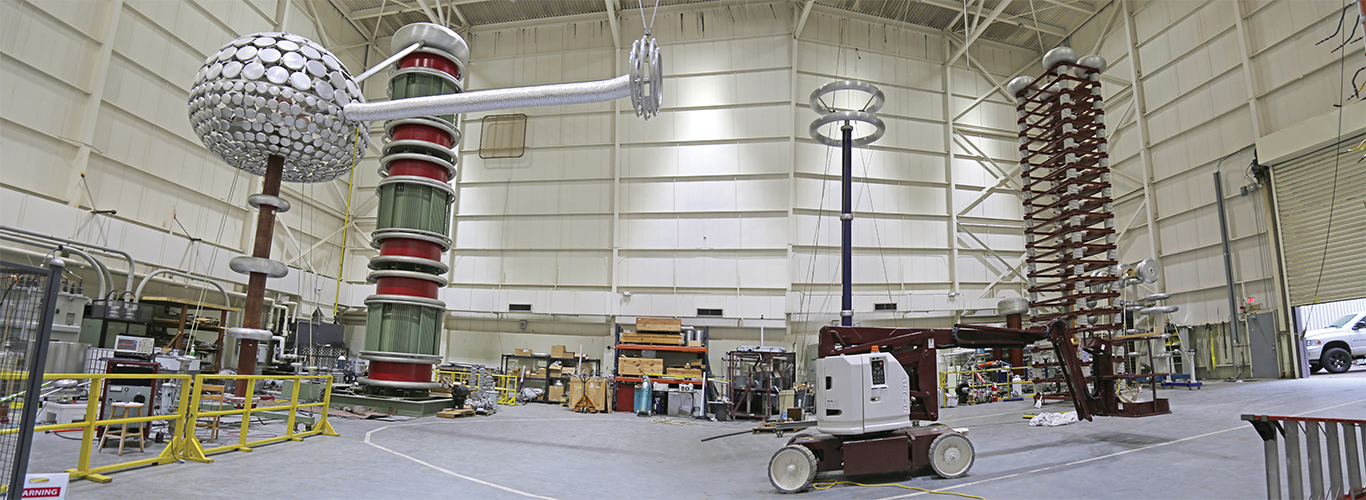
The High Voltage Laboratory is one of the MSU research units and serves as an independent, non-industrial, university center for high voltage engineering. The mission of the High Voltage Laboratory includes the following:  research, evaluation/testing, and education activities.


The principal objective of this multi-purpose, high voltage facility is to provide a broader effort designed to meet the research and evaluation/testing needs of industry and the necessary environment for a basic academic program associated with high voltage engineering. The High Voltage Laboratory, constructed as part of the Simrall Electrical Engineering Building, was occupied in 1977. The main laboratory has a floor area of 33.5 x 24.5 m and a minimum ceiling height of 15.2 m. This is the largest high voltage laboratory among North American universities.


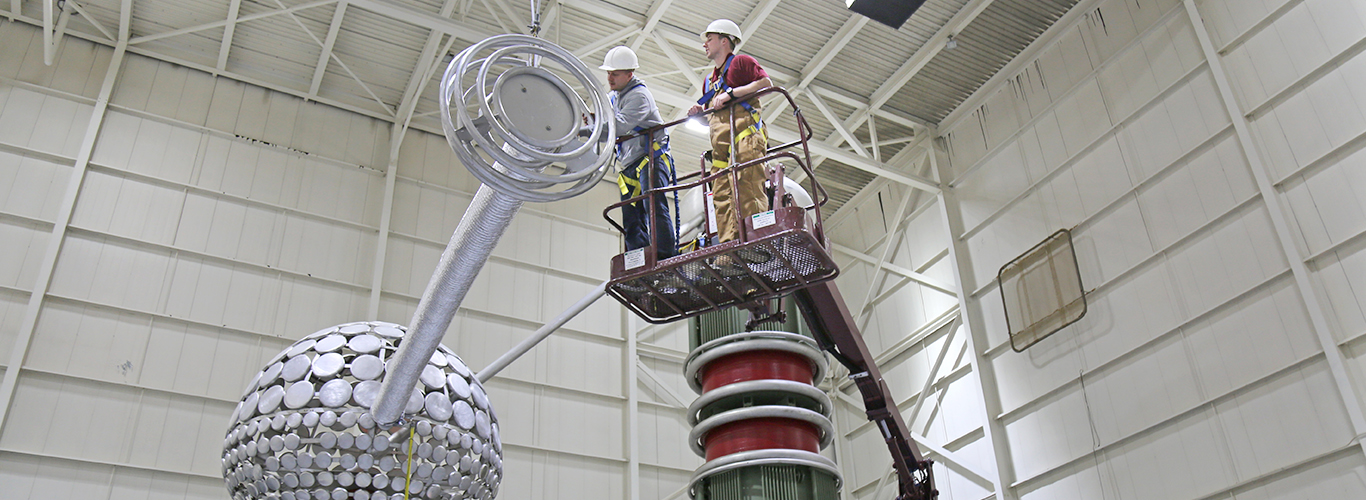
The impulse equipment consists of a 3000 kV, 56 kJ impulse generator, conventional voltage dividers, impulse oscilloscopes and a digital oscilloscope/waveform analyzer. The 60 Hz equipment consists of a 1000 kV, 1000 kVA conventional test transformer and a power follow transformer with maximum short circuit capability of 10 MVA. The direct voltage supply consists of a 1050 kV, 7 kW DC test set. Other auxiliary equipment include: partial discharge measurement system, fog chamber, modern night scope, wet test facilities and a computer system for data analysis and storage.